Descriptive Astronomy 101
The Moon
The Moon

Average Distance from Earth = 384,400 km
Orbital Period = 27.32 days
Rotational Period = 27.32 days
Diameter = 3,476 km
Density = 3.36 g/cm3
Gravity = 16.7% of Earth's gravity
Surface temperature = -170° to 130° C (-274° to 266°F)
Inclination of Orbit to Ecliptic = 5°9'

Earth and Moon
Unusual combination - the Moon is very large when compared to the Earth
Earth - mass = 5.976 x 1027 g
- radius = 6,378 km
Moon - mass = 7.35 x 1025 g
- radius = 1,738 km

Phases of the Moon
The Moon is illuminated by light from the Sun.
The Moon is a sphere and only that hemisphere facing the Sun is illuminated.
This light is then reflected off of the surface toward the Earth. Albedo =
• Phase Terminology
• Phase Orbit Positions


Lunar Time Keeping
Sidereal Month
Based on orbital movement of the Moon
Synodic Month
Based on phases of the Moon
Tides
The Earth's oceans and crust are gravitationally attracted to the Moon and the Sun.
This creates "bulges" in the ocean and crust on the side of the Earth facing the Moon.
A bulge is also created on the side of the Earth away the Moon.
Created due to differences in gravitational attraction.
Rotation of the Earth causes the bulge to be swept forward.
Bulge causes two effects:
1.
2.

Interior Structure

Known to have a differentiated core, mantle and crust.
Core:
Mantle/crust:
Tectonic Activity
No substantial tectonic activity
Moonquakes
Largest moonquakes are only magnitude 5 on the Richter scale
Causes?
Volcanism
Lunar Maria - "Lunar Seas"
Generally smooth and level plains of extensive basalt lava flows
Extensive volcanism occurred between 3.9 and 3.2 billion years ago - filled many of the large craters and basins
Domes
Cinder cone eruptions - pyroclastic volcanoes
"Dark mantle deposits" - pyroclastic deposits


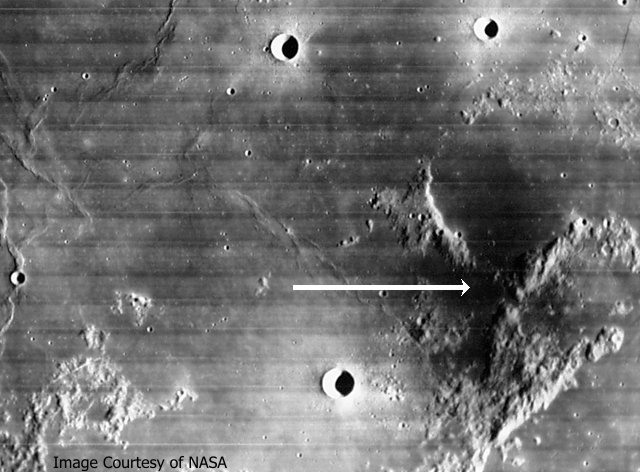
Volcanic Rocks
Basalt - olivine, pyroxene and plagioclase:
Anorthosite - 90% plagioclase:
Norite - 60% plagioclase, 35% pyroxene, 5% olivine:
Troctolite - 60% plagioclase, 5% pyroxene, 35% olivine:
Impact Craters
Highlands
Lunar craters are typically circular
Small craters (simple craters) are <16 km diameter and show smooth bowl- or cone-shaped interiors (flat bottoms) - exterior deposits slope away from rim
Large craters (complex craters and basins) - roughly circular, terraced rims with a central peak or ring peak, surrounded by hummocky debris; >16 km diameter
Impact Basins
The term applied to lunar craters larger than 200 km is basin
Similar structure to Lunar large craters, but larger - roughly circular, terraced rims with a central peak or ring peak, surrounded by hummocky debris - multi-ringed - lava flows often the basin


Erosion on the Moon
No atmosphere - no eolian or fluvial processes
Impact Cratering:
Mass Wasting:
Space Weathering
Origin of the Moon
Observations:
1) Composition is similar to Earth's Mantle
2) Ratios of 16O, 17O, 18O are similar to Earth's
3) Earth-Moon pair has a great deal of angular momentum
4) Moon's orbit does not lie in the plane of the Earth's equator or Ecliptic
5) Moon is gradually receding from the Earth

Co-Accretion Theory (Sister or Co-formation Theory)
The Moon and Earth formed as separate bodies from material in the Solar Nebula - double planet system
Flaws:
Capture Theory
The Moon formed in another part of the Solar Nebula
Gravitationally captured by the Earth when its orbit brought it close to the Earth
Flaws:
Fission Theory
Moon was originally part of the Earth
Earth split into two parts due to rapid rotation of a young, molten Earth
Flaws:
Giant Impact Theory
Large impact with a Mars-sized body resulted in material being ejected into orbit
Material coalesced to form the Moon
Glancing impact left core of body in the Earth, mantle material is ejected
Flaws:
Lunar History
1. Giant impact with Earth - material ejected from surface coalesced to form the Moon
2. Magma Ocean forms - 500 km thick (?):
3. Additional magma is produced to form norite and troctolite:
4. Impact bombardment:
5. Intense bombardment:
6. Maria lava flows and pyroclastic eruptions of basalt:
7. Regolith formation due to continued, low rate of impacts and space weathering:
8.