Physical Geography 101
Humidity, Clouds and Fog
Humidity
Defined as water vapor present in the air.
At most, the total amount of water in the atmosphere is 4-5% of a given volume of air.
Measured in various ways - most common are discussed below.
Absolute Humidity
Defined as the mass of water vapor present per volume of air.

Not commonly used due to changes in volume in air masses
Specific Humidity
Defined as the mass of water vapor present per mass of air.

This is a measure of the quantity of water that can be extracted from the atmosphere as precipitation.
Relative Humidity
Defined as the ratio of the amount of water vapor present to the amount of water vapor that the air can hold. The result is reported as a percentage.

Two ways that RH can change:
1)
2)

Dew-Point Temperature
The temperature at which the Relative Humidity will equal 100% if the air is cooled.
Adiabatic Process
Simply stated - compression causes air to warm, while expansion causes air to cool.
As an air mass rises in altitude it will expand. As it expands it cools.
If the same air mass sinks to a lower altitude it will be compressed. As it is compressed it warms.
Adiabatic warming and cooling occurs at a given rate known as the Dry Adiabatic Lapse Rate:
10°C/1000 m (5.5°F/1000 ft)
This means that for every rise in elevation of 1000 meters the air temperature will cool (decrease) by 10°C.
The same air mass will increase its temperature by 10°C for every 1000 meters that it sinks in elevation.
The Dry Adiabatic Lapse Rate is followed as long as no condensation occurs in the air mass.
If condensation is occurring during cooling, then a Wet Adiabatic Lapse Rate is followed.
Cloud Formation
Example:
1) Air mass starts at 0 meters, 20°C
2) As air mass rises it cools: 10°C/1000m - the Dry Adiabatic Lapse Rate
3) At 1000m, temperature has dropped to 10°C.
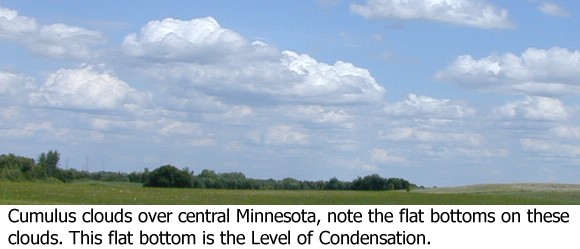
4) In this example, this is the elevation at which condensation starts - Level of Condensation
- Relative Humidity = 100%
- Dew Point Temperature = 10°C
5) Condensation results in formation of water droplets - clouds form
6) Air continues to rise following the Wet Adiabatic Lapse Rate of 3°C/1000m
- Wet Adiabatic Lapse Rate is a slower cooling rate than the Dry Adiabatic Lapse Rate
- Cooling has slowed due to condensation
- The changing of water vapor to liquid water results in the release of latent heat, which helps to keep the air warm
Clouds

Made of water droplets or ice particles suspended in air
Water condenses onto aerosol particles - dust, salt, water, etc.
Cloud Forms
Based on elevation
Four families of cloud forms
1) High Altitude
2) Middle Altitude
3) Low Altitude
4) Vertical Development
Two Classes of cloud forms
1) Stratiform - sheet-like or blanket-like clouds
- cover large areas
- form when large air masses rise gradually
2) Cumuliform - globular, puffy clouds
- individual cloud masses
- form from individual masses of rising air
Fog - a cloud layer at or close to ground level