Physical Geology 101
Structural Geology
Tectonic Structures
Tectonics: study of crustal deformation and structural behavior.
Plate Tectonics: deformation and structural behavior of crustal plates.
Stress
Stress is any force which acts to deform rocks.
Compression - a stress that acts to press or squeeze rocks together.
Tension - a stress that acts to stretch a rock, or pull a rock apart.
Shear - a stress which acts tangential to a plane through a body, causing two contiguous parts to slide past each other.
Structural Behavior
As a general rule: Rocks tend to have
1)
2)
Strain
When a stress is applied, deformation may occur
Strain: change in shape or volume of a body as a result of stress; deformation.
Brittle and Ductile deformation.
Ductile Deformation
During ductile deformation rocks bend or flow.
Specifically defined as a rock that is able to sustain, under a given set of conditions, 5-10% deformation before fracturing.
Ductile Deformation Example 1
Ductile Deformation Example 2


Anticlines
Folds which arch up
Anticline Example #1
Anticline Example #2
Anticline Block Diagram
Click here to view an animated Anticline development.


Synclines
Folds which sink down
Syncline Example #1
Syncline Example #2
Syncline Example #3
Syncline Block Diagram
Click here to view an animated Syncline development.


Monoclines
Folds in which rock layers on both sides of the fold are horizontal but at different levels.
Monocline Example #1
Monocline Example #2
Monocline Example #3
MonoclineExample #4
Monocline Example #5
Monocline Block Diagram
Click here to view an animated Monocline development.


Domes
Equivalant to anticlines, but are comprised of layers which are shaped like an inverted bowl.
Emigrant Gap Dome Example #1
Sundance Dome Example #2


Basins
Folds which are equivalent to synclines, but are comprised of layers which are shaped like a bowl.
Basin Example #1


Brittle Deformation
During brittle deformation rocks break or fracture.
Two main styles of fracture: Joints and Faults.
Joints
Fracture along which there has been no displacement.
Joint sets and jointing has a major influence on landform development.
Erosion is able to occur at a faster rate along joints.
Joints Example #1
Joints Example #2


Faults
Faults are fractures along which there has been displacement of the material on either side of the fault.
Faults are classified based on:
1) sense of movement (the direction in which the blocks on either side of the fault move)
2) orientation of the fault surface (the angle of the plane of fracture)
Fault Terminology
Fault Plane - the plane along which the rock or crustal material has fractured.
Fault Scarp
Hanging Wall Block - the rock material which lies above the fault plane.
Footwall Block - the rock material which lies below the fault plane.

Strike-Slip Faults
Fault plane is generally vertical.
Movement is horizontal due to shear stress.
1) Left-Lateral Strike-Slip - displacement is such that the material on the other side of the fault appears to be displaced to the left.
Left-Lateral Block Diagram
2) Right-Lateral Strike-Slip - displacement is such that the material on the other side of the fault appears to be displaced to the right.
Right-Lateral Example
Right-Lateral Block Diagram


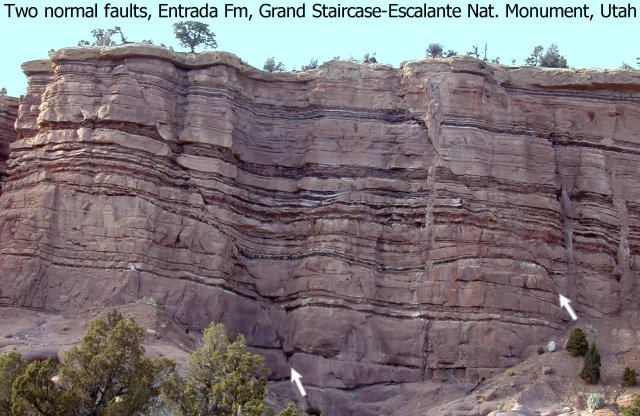
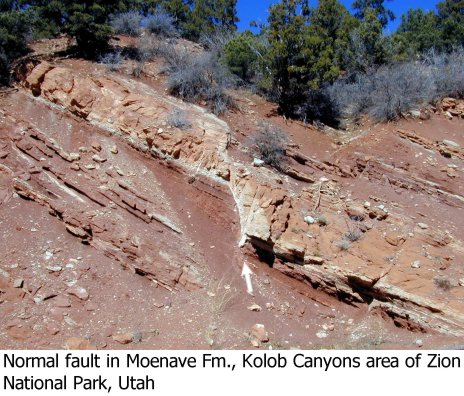
Normal Faults
Fault plane is oriented between 30 and 90 degrees (measured from horizontal)
Movement has both a horizontal and vertical component.
Normal faults result from tensional stress and results in the hanging wall moving down relative to the footwall.
Block Diagram
Normal Fault Example 1
Normal Fault Example 2
Normal Fault Example 3
Normal Fault Example 4
Normal Fault Example 5
Normal Fault Example 6
Normal Fault Example 7
Normal Fault Example 8



Detachment Faults
Fault plane is at less than 30 degrees
Movement is more horizontal than vertical due to the low angle of the fault plane.
Develop due to tensional stress.
Detachment Fault Block Diagram
Detachment Fault Example 1


Reverse Faults
Fault plane is oriented between 30 and 90 degrees (measured from horizontal)
Movement has both a horizontal and vertical component.
Reverse faults result from compressional stress and results in the hanging wall moving up relative to the footwall.
Reverse Fault Block Diagram
Reverse Fault Example 1
Reverse Fault Example 2
Reverse Fault Example 3
Reverse Fault Example 4


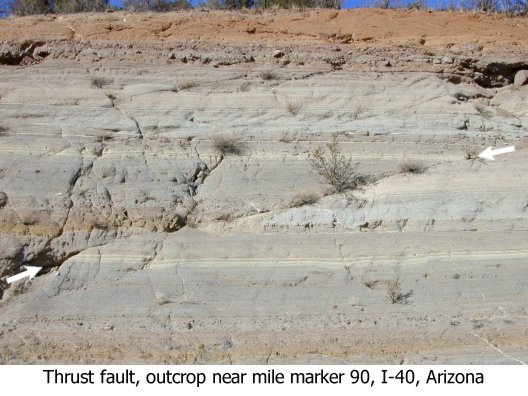
Thrust Faults
Fault plane is at less than 30 degrees
Movement is more horizontal than vertical due to the low angle of the fault plane.
Develop due to compressional stress and results in the hanging wall moving up relative to the footwall.
Thrust Fault Block Diagram
Thrust Fault Example 1
Thrust Fault Example 2 - Thrust Fault Example 2 Diagram
Thrust Fault Example 3



Horsts and Grabens
Horsts are up thrown blocks bounded on either side by non-parallel normal faults.
Grabens are downthrown blocks bounded on either side by non-parallel normal faults.
• Horst and Graben Block Diagram


Click here to view an animated Horst-Graben development.

Half-Graben
Half-grabens develop when parallel faults on either side of a block develop, but the block becomes tilted instead of dropping down as in a graben.
• Half-Graben Block Diagram


Faulted Terrain
Erosion is able to occur at a faster rate along joints and faults.
Greater amount of surface area.
Rock is already broken into smaller parts - Broken material is easier to remove.
Many stream valleys follow fault zones.
Click here to view an animated Half-Graben development.

Fault Map Symbols

Measurement of Orientation
Strike - compass direction of the outcrop
- the line formed by the intersection of a horizontal plane with the
structure.
Dip - the angle between the horizontal plane and the planar surface
being measured.
- Dip is always perpendicular to Strike
