Historical Geology 102
Mesozoic Era I
Mesozoic Era
3 Periods
Triassic 245-208 m.y.
Jurassic 208-144 m.y.
Cretaceous 144-66 m.y.
Tectonic activity switches to west
Break up of Pangaea
Triassic Paleogeography
Jurassic Paleogeography
Jurassic Paleogeography
Cretaceous Paleogeography
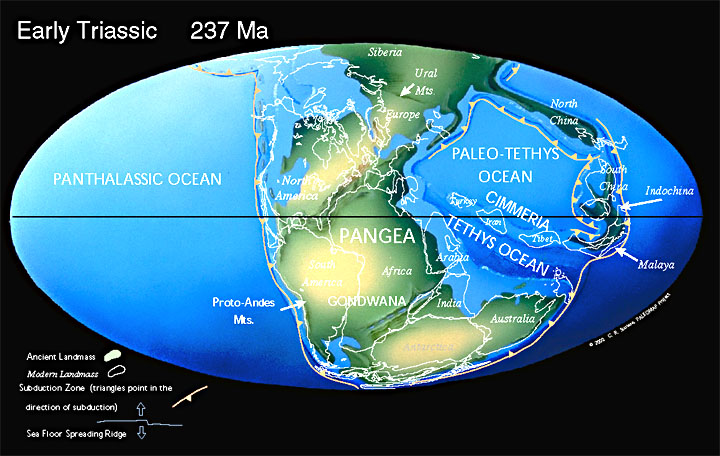
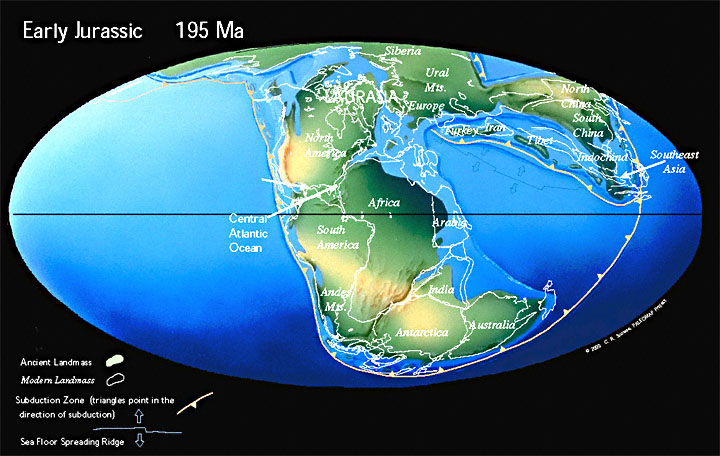
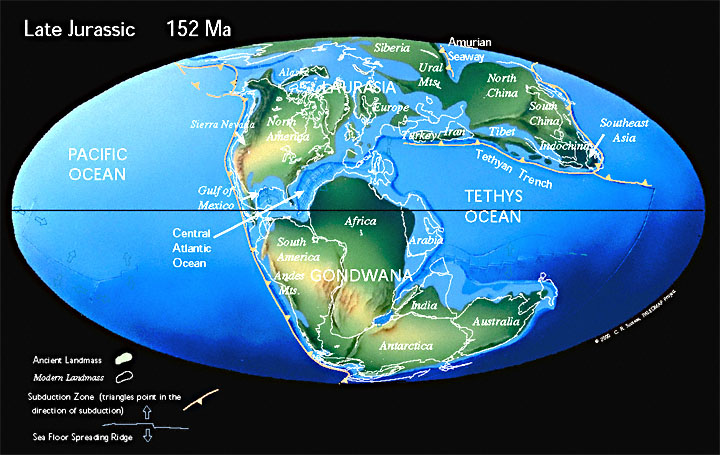
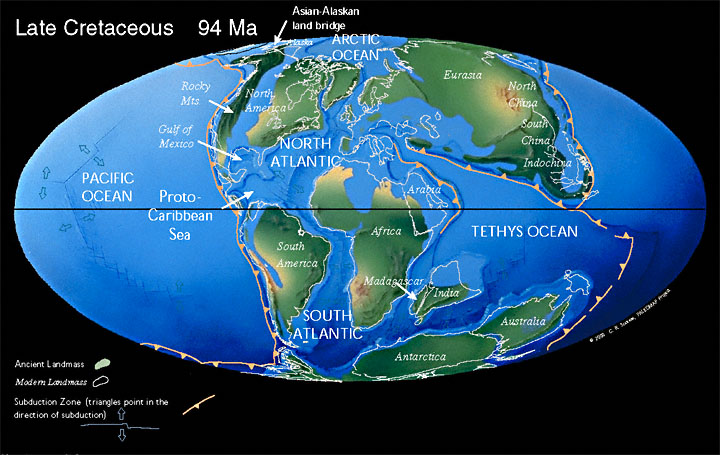
East Coast
Erosion of the Appalachians
Late Triassic to early Jurassic - Pangaea begins to break up
Gondwanaland diverges from Laurasia
North America begins splitting from Eurasia
N.A. Eastern Margin
Extensive normal faulting east of the Appalachians
Erosion of the Appalachians
Thick accumulations of arkosic, red sandstones and shale - Newark Group
Extensive volcanic and intrusive igneous activity
Palisades Sill
Best known of the intrusive igneous rocks
Diabase
- mafic composition
- intruded 0-4 km below surface
Crystal settling
- olivine at the bottom
- quartz at the top
Gulf of Mexico
Rifting along the southern margin begins in the late Triassic Period
Initial deposits
- evaporites
- restricted basin
As rifting continued, basin becomes less restricted
- normal marine deposition develops
Zuni Sequence

Transgression along eastern and southern margins
Thick accumulation of marine and deltaic deposits
Large volcanic wedges associated with these deposits
Passive margin develops
Tectonic Eustasy
Zuni transgression was a world wide event
Divergent boundaries can influence sea level
Rate of divergence
Fast spreading center - hot material rising causes mid-ocean ridge to float higher
Ocean is displaced onto continents
Global Events - Africa
Global Mesozoic rock record is poor
Karroo Basin is an exception
Basin formed in the late Carboniferous
Important for two reasons
Global Events - India
India separates from Gondwana in late Triassic
Drifts northward
70-65 m.y. - huge outpouring of flood basalt
- Deccan Traps
May be result of India moving over a hot spot.
Global Events - South America
Divergence from Africa in Jurassic
Subduction zone develops on western margin
Deformation and volcanism form the Andes