Historical Geology 102
Mesozoic Era II
Mesozoic Era
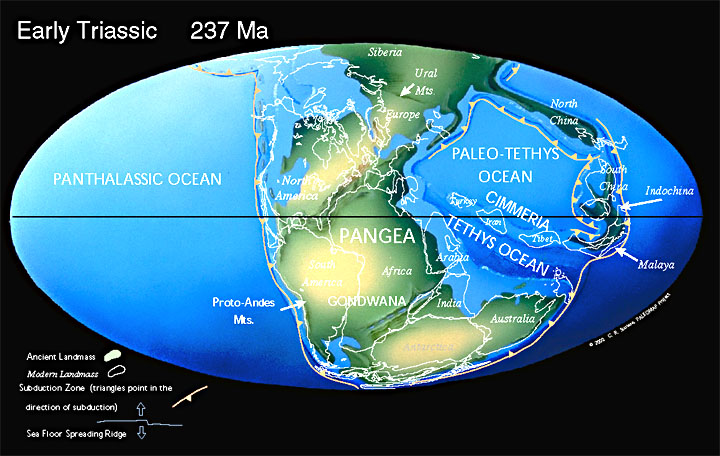
Triassic Paleogeography
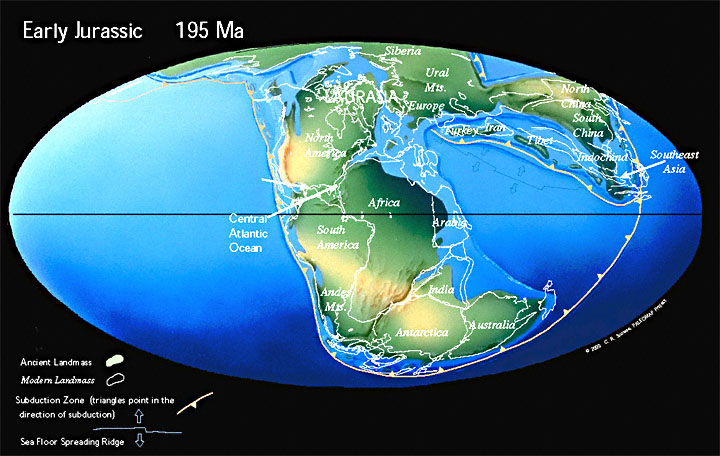
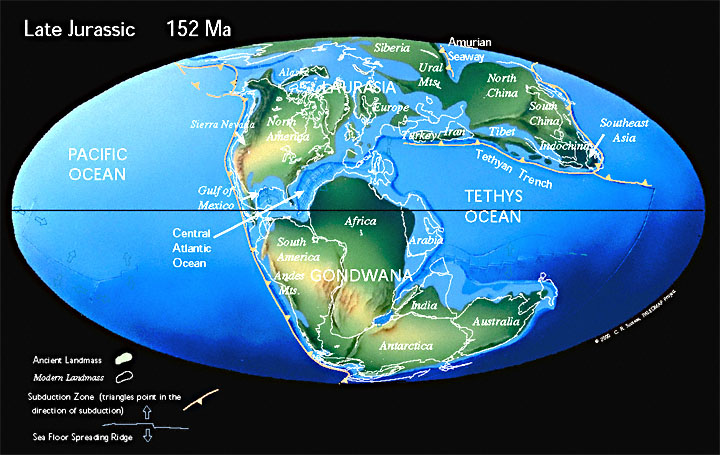
Jurassic Paleogeography
Jurassic Paleogeography
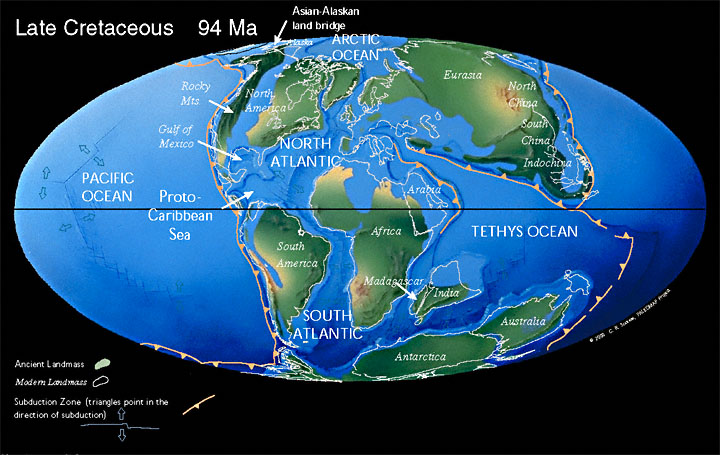
Cretaceous Paleogeography
Cordilleran Orogeny - Major orogenic event - divided into three or four orogenic episodes
Sonoma Orogeny
Nevadan Orogeny
Sevier Orogeny
Laramide Orogeny
Accretionary Tectonics
North America drifts westward - subduction zone develops along the west coast
Oceanic crust is not a simple slab of basaltic crust - also contains volcanic arcs, sea mounts, and microcontinents
Accretionary Tectonics
As crust is subducted these features are scraped off by the North American continent - become part of the continent
Accretionary Tectonics
Allochthons are accreted terrains
Also called Suspect Terrains
More than 50 such terrains in western North America
Sonoma Orogeny
Late Permian to Middle Triassic event
Collision of volcanic island arcs along the southwest margin of North America
Accretionary tectonic event
Nevadan Orogeny
Large plutonic igneous bodies
Sediment eroded from the continent was deposited in the subduction zone
Melting of this material produced granite and granodiorite magma
Plutons were emplaced in Baja California, Sierra Nevada Range, Idaho and the Coastal Range Batholith of British Columbia
Intrusions initially occurred along coastal areas
Emplacement shifted inland to Nevada/Idaho during Cretaceous Period due to changing angle of subduction

Sevier Orogeny
Subduction zone related
Overlaps with Nevadan Orogeny
Crustal deformation due to compression forces generated along the convergent plate boundary
Deformation forces transmitted eastward which resulted in a series of low angle thrust faults
Forms north-south trending mountain ranges east of the Nevadan plutons
Sevier Orogeny often implies Nevada and Utah ranges but also includes western Canada and Montana
Laramide Orogeny
Began in the Cretaceous, but is primarily a Cenozoic event
Deformation occurred inland from the plate margin
Crustal deformation resulting in uplift, arched domes, basins, and large anticlines
Believed to be the result of subduction of the Farallon Plate beneath North America
Farallon Plate = Juan de Fuca Plate + Cocos Plate + subducted portion of plate
Subduction along entire west coast
Subduction at an angle of ~50 degrees
Volcanic activity 150-200 km from trench
Angle of subduction decreased, resulting in Farallon Plate moving nearly horizontal beneath North America
Volcanism shifted inland - eventually ceases
Deformation results in large scale fracturing and buckling, i.e. fault-bounded uplifts and gentle folding
Rocky Mountains
Triassic Sedimentation
Most notable in SW United States
Terrestrial sediments - fluvial and desert sedimentation
Chinle Formation
Painted Desert in Arizona and Petrified Forest Nat. Monument
Jurassic-Cretaceous Sedimentation
Navajo Sandstone
Arid conditions resulted in extensive dune deposits in coastal dune fields
Jurassic-Cretaceous Sedimentation
Morrison Formation & Sundance Formation
Sundance Sea transgression - Jurassic Period (Zuni sequence)
Sedimentation deposited in a vast swampy plain of silt and mud
Famous for its dinosaur fossils
Jurassic-Cretaceous Sedimentation
Dakota Group
Deposited during the Zuni Sequence transgression
Dakota Sandstone was deposited as beach deposits during the transgression
